

Anara
Search, read and cite scientific papers with an AI research assistant that shows its sources.
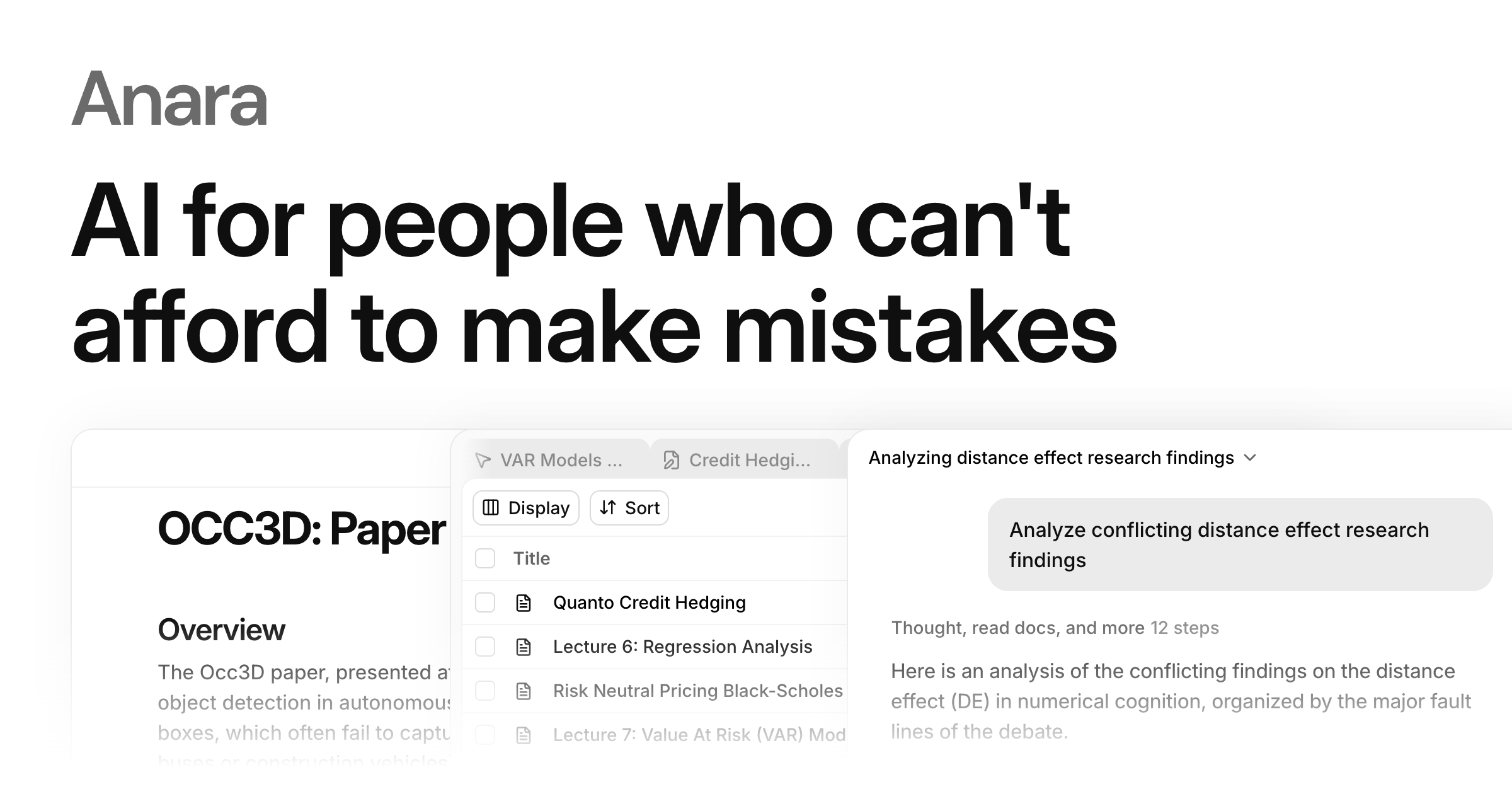
Anara is an AI research assistant built for scientific literature. It finds papers, reads your documents, answers questions by citing the exact passage and helps you write with references you can check. It is aimed at students, academic researchers and industry teams, particularly in healthcare and biotech.
The tool was called Unriddle until March 2025, when it was renamed Anara. It is developed by Anara Labs, Inc., a San Francisco company founded in 2023 by Naveed Janmohamed and backed by Y Combinator (Summer 2024 batch).
How does Anara work?
You can search a database of more than 300 million papers, filtering by journal, year or citation count, or bring your own files: PDFs, notes, slides, recordings, references by DOI, PMID or URL, and Zotero or Mendeley libraries. Anara keeps everything on hand. You then ask questions of one paper, a folder or your whole library, and every answer links back to the source passage, highlighted in the document.
Two features go further. Extraction turns a folder into a table, with one row per paper and one column per question, a citation for every cell and export to CSV or Excel. The notes editor suggests citations from your library and exports to Word, LaTeX or BibTeX in the style you need. Anara works on the web, Mac, iPhone and iPad, inside Microsoft Word and from Claude or ChatGPT.
Anara pricing in 2026
The free plan needs no card. It includes limited AI usage that refreshes daily and uploads of up to 20MB or 120 pages. Paid plans are priced per seat, in US dollars. Plus costs $10 a month ($8 billed yearly). Pro, at $20 a month ($16 billed yearly), gives four times more usage, the strongest AI models and support for scanned documents. Max, at $100 or $200 a month ($80 or $160 billed yearly), is built for heavy use and adds Deep Search. A custom-priced Enterprise plan adds SSO among other things. There is no student discount, but you can ask for a refund within 7 days of your first payment.
Our verdict on Anara
Pros: passage-level citations that are easy to check, a real research library rather than a simple chat with a PDF, and tools designed for literature reviews (extraction tables, BibTeX export, Zotero).
Cons: pricing is complex, with usage meters and credits, and data is processed in the United States. The accuracy figures it highlights come from its own benchmarks. Like any AI, Anara can get things wrong, and its terms of use make no promise of accuracy.
Anara alternatives
- NotebookLM: Google's research tool for asking questions about your own documents.
- Elicit: an assistant dedicated to analysing academic research.
- ChatPDF: a simple way to chat with a PDF file.
- Humata AI: cited answers about any document.
Frequently asked questions
Is Anara free?
Yes. The free plan needs no card and gives you limited AI usage that refreshes every day. Paid plans start at $8 a month billed yearly.
Which languages does Anara support?
The website is in English. The iPhone and iPad app is available in 32 languages, including English, French, German and Spanish.
Is my data private on Anara?
Anara processes data in the United States and sends only the relevant passages to its AI providers (OpenAI, Anthropic, Google and xAI), under zero data retention terms. The company says it is GDPR compliant, but its privacy policy allows data to be used for internal model training. Users must be 18 or older, or have a parent's consent.
Features
Key features
- 300M+ papers: search filtered by journal, year or citations, including PubMed and clinical trial registries.
- Personal library: papers, notes, slides and recordings, import by DOI, PMID or URL, Zotero and Mendeley sync.
- Cited answers: every answer links to the exact passage, highlighted in the document.
- Table extraction: one row per paper, one column per question, every cell cited, CSV and Excel export.
- Writing with citations: export to Word, LaTeX or BibTeX in any citation style.
- Collaboration: folders shared with collaborators.
- Cross-platform: web, Mac, iPhone, iPad, a Microsoft Word add-in and access from Claude or ChatGPT.